
Verify regulatory status first
Spot AI Trading Scams works best as a clear sequence: define the constraint, compare the realistic options, test the tradeoff, and choose the path with the fewest hidden costs. That order keeps the advice usable instead of decorative. After each step, pause long enough to check whether the recommendation still fits the reader's actual situation. If it depends on perfect timing, unusual access, or a best-case budget, include a simpler fallback.



Test the bot with a demo account
Before depositing real capital, demand a risk-free trial period. A legitimate AI trading provider will offer a demo account that mirrors live market conditions using virtual funds. This step allows you to verify performance claims without financial exposure.
Scammers often skip this phase or provide "demo" accounts where results are pre-scripted. If a provider refuses to let you test the software first, treat it as a red flag. You need to see how the bot handles volatility, not just how it performs in a controlled, fake environment.
1. Request access to a live demo environment
Look for a dedicated demo portal or a "paper trading" mode within the platform. Ensure the demo uses real-time market data, not delayed feeds. Delayed data can mask slippage and execution delays that will hurt your account once you go live.
2. Run the bot through varied market conditions
Don't just watch the bot make money on a trending day. Run it for at least two weeks across different market cycles. Check how it handles sudden drops or high volatility. A robust AI trading system should have clear drawdown limits, not just upward spikes.
3. Verify withdrawal mechanics in the demo
Some platforms let you "withdraw" demo profits to prove the interface works, but this is often a trick to build false confidence. The real test is whether the platform allows you to exit positions cleanly. If you cannot close a trade or withdraw virtual funds easily, you won't be able to do it with real money.
4. Check for hidden fees or subscription traps
Even in demo mode, some platforms require credit card details for "verification." Be cautious. If the provider demands payment information to use the demo, they are likely fishing for payment data or preparing to charge you for a service you haven't tested. Legitimate platforms do not require payment info for a free trial.
5. Compare demo results against published claims
If the bot claims 20% monthly returns, check if the demo account reflects that consistency. Scammers often show cherry-picked screenshots. The demo account is your only unbiased source of truth. If the demo performance is flat or erratic, the marketing claims are likely fabricated.
Check for unrealistic return promises
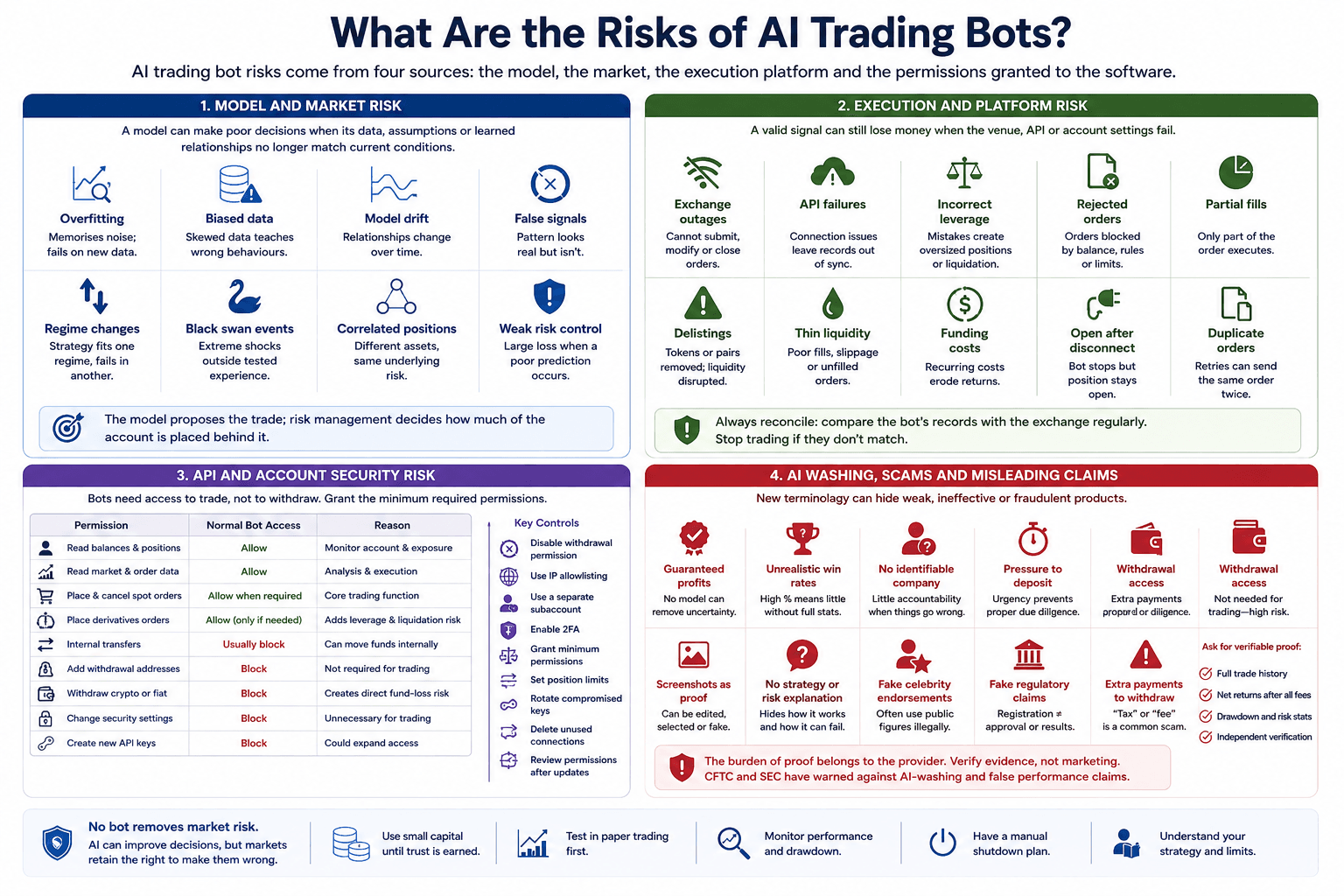
Scammers rely on a simple psychological trigger: the promise of effortless wealth. When an AI trading platform guarantees high returns with zero risk, it is almost certainly a scam. In 2026, fraudsters are increasingly using "AI-powered trading bots" to justify these impossible claims, suggesting that algorithms can predict market movements better than any human trader.
Regulators have flagged this tactic repeatedly. The Australian Securities and Investments Commission (ASIC) warns that claims of passive income through AI bots are "very unlikely" to be legitimate. These platforms often use sophisticated marketing to mask the fact that they are simply stealing deposits rather than executing trades.
The Red Flags of Guaranteed Returns
To protect your capital, treat any promise of fixed or high returns as a major warning sign. Legitimate trading involves risk, and no algorithm can eliminate market volatility. Look for these specific indicators:
- Guaranteed Profits: No legitimate financial product guarantees returns. If a platform promises a specific percentage gain per day or week, it is a scam.
- Risk-Free Claims: All trading carries risk. Platforms claiming "zero risk" are misleading investors.
- Passive Income Promises: AI tools can assist analysis, but they cannot generate passive income without human oversight or significant capital risk.
Verify the Source
Before depositing funds, check if the platform is regulated by a recognized financial authority. Unregulated platforms offering unrealistic returns are operating outside the law and offer no consumer protection. If a claim sounds too good to be true, it is.
"Scammers claiming their trading bots use AI to generate passive income and unachievable returns." — ASIC Media Release, 2026
When evaluating an AI trading opportunity, focus on transparency and realistic expectations. If the returns seem magical, your money will likely disappear just as quickly.
Review withdrawal policies carefully
Scammers rarely make it easy for you to leave. Their business model relies on keeping your capital trapped in their platform until the site vanishes or the account is frozen. Before you deposit a single dollar, treat the withdrawal section of their terms of service with the same scrutiny you apply to their trading claims.

Legitimate trading platforms allow you to withdraw funds on demand, often within 24 to 48 hours. Scam sites often impose arbitrary "lock-up" periods where your money is inaccessible for 30, 60, or even 90 days. If the platform claims you must wait for a specific "trading cycle" or "AI model update" to access your principal, it is a major red flag. The California Department of Financial Protection and Innovation (DFPI) has flagged these artificial delays as a common tactic in AI investment fraud.
Transparent platforms list all fees upfront: spreads, commissions, and withdrawal charges. Scam sites often bury complex fee structures in fine print or introduce new penalties after you sign up. Look for vague terms like "administrative processing fees," "tax compliance charges," or "withdrawal penalties" that are deducted from your balance before you receive your money. If the fee structure changes without clear notice, the platform is designed to erode your capital.
Be wary of platforms that only allow withdrawals back to the original deposit method, especially if that method was a cryptocurrency wallet or wire transfer. These methods are difficult to reverse and leave little paper trail. Legitimate brokers offer multiple, verifiable withdrawal options, including direct bank transfers to accounts in your name. If the site insists on using obscure payment processors or requires you to send additional "fees" via crypto to release your funds, stop immediately.
Before committing significant capital, make a small deposit and attempt a withdrawal. Note how long it takes, who approves it, and if any unexpected hurdles appear. Scam sites often allow small withdrawals initially to build trust, then block larger amounts by claiming you haven't met "trading volume requirements." A legitimate platform will never require you to trade a certain amount before withdrawing your own money.
The goal is to ensure you can exit the platform as easily as you entered it. If the exit is difficult, the platform is not a trading service; it is a trap.
Common AI trading scam types
AI-driven fraud has evolved from crude phishing emails into sophisticated, personalized attacks that mimic trusted financial institutions. In 2025, AI scams surged 1,210% globally, far outpacing traditional fraud growth, with projected losses reaching $40 billion by 2027 [[src-serp-1]]. Understanding these specific vectors is essential for protecting your capital.
Voice cloning and synthetic audio
Fraudsters now use voice cloning software to replicate the exact tone and cadence of family members or financial advisors. These deepfake audio calls often create a sense of urgency, claiming an account has been compromised and demanding immediate transfer of funds to a "secure" account. Unlike traditional impersonation, these calls are indistinguishable from real conversations, bypassing the skepticism that usually triggers when receiving unexpected calls about money.
AI-generated trading signals and bots
Scammers deploy AI-powered chatbots to create the illusion of a profitable trading algorithm. These bots analyze market data to generate "winning" signals, often sharing fabricated screenshots of high returns. The AI engages in continuous conversation, answering objections and building trust over days or weeks. Once the victim deposits funds, the bot disappears, and the trading platform becomes inaccessible. This method exploits the desire for passive income and the complexity of modern markets.
Deepfake video endorsements
High-profile figures are no longer safe from impersonation. Scammers use deepfake video technology to create fake endorsements of cryptocurrency schemes or trading platforms. These videos feature convincing likenesses of CEOs or influencers promoting a specific asset, often with fabricated testimonials from other "investors." The realism of these videos tricks viewers into believing the opportunity is legitimate and vetted by industry leaders.
AI-curated romance and crypto scams
AI has scaled romance scams by automating the emotional manipulation phase. Bots analyze social media profiles to craft personalized messages that mimic genuine romantic interest. Once a connection is established, the scammer guides the victim toward a fake crypto trading platform. In 2025, AI-powered crypto romance scams surged 20%, demonstrating how automation lowers the cost of execution for fraudsters while increasing the volume of victims [[src-serp-5]].

No comments yet. Be the first to share your thoughts!